
This article shares general educational information rather than a property-specific engineering assessment. A qualified professional should evaluate significant movement, structural damage and safety concerns.
What a contractor assessment can provide
A repair contractor may evaluate visible conditions, take measurements and recommend a repair system within its expertise. Some evaluations are free because the company hopes to sell services.
What an engineer may provide
A Texas-licensed professional engineer may perform a defined structural assessment and provide an engineering opinion or report according to the agreed scope. Not all engineer visits include a full repair design, so clarify deliverables.
- Scope and limitations of evaluation
- Observations and supporting analysis
- Recommendations for additional testing
- Any design or report explicitly included
When independent evaluation is particularly valuable
Conflicting repair proposals, significant structural change, unusual foundation systems, purchase and sale disputes or costly underpinning recommendations are reasons to consider a separate qualified opinion.
Ask the right questions before booking
Find out whether measurements, a signed report, photographs, drawings or repair specifications are included. Confirm whether the professional has relevant local foundation experience and the required license.
What a contractor foundation inspection usually means
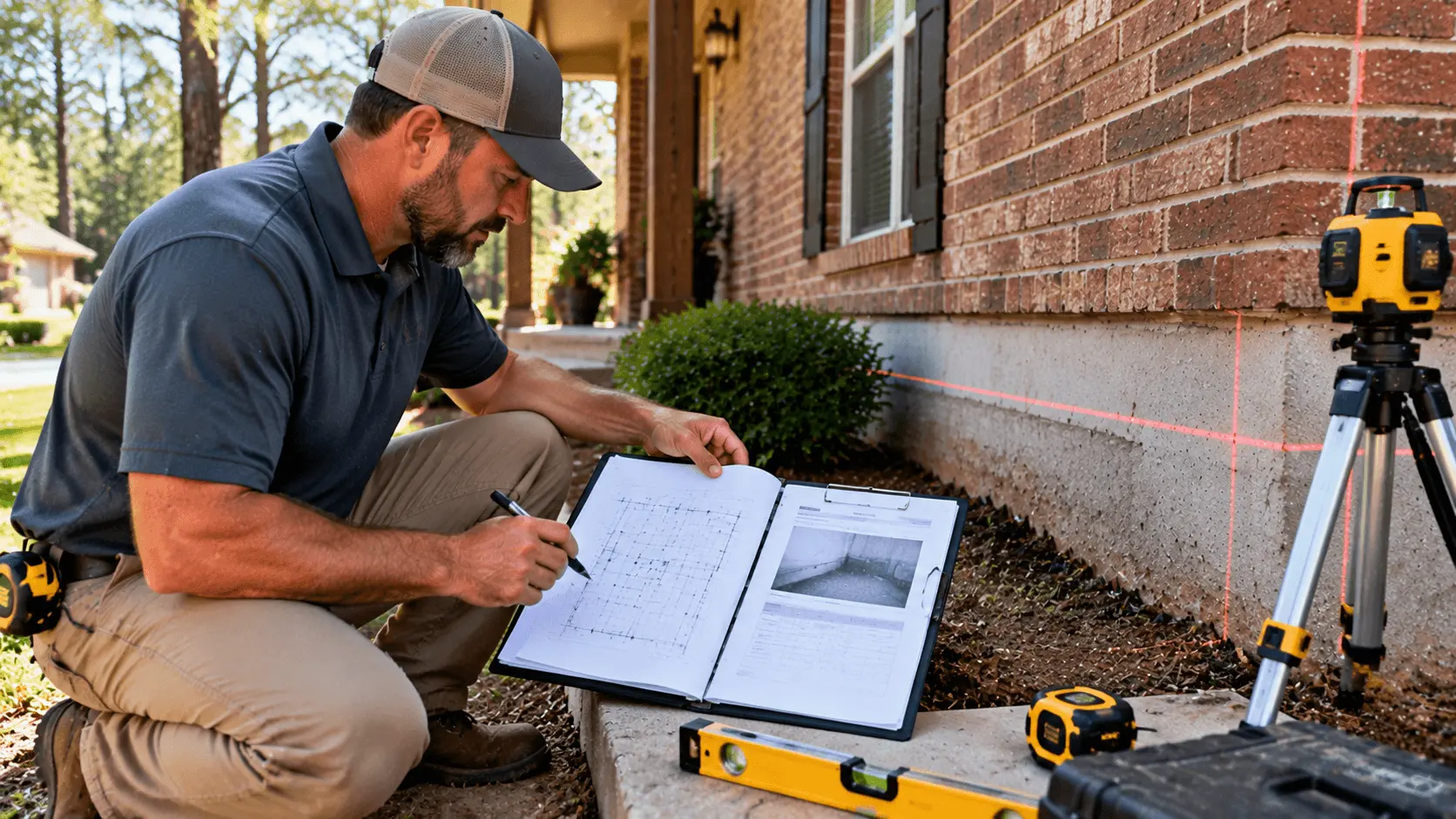
A repair company's assessment may include a walk-through, visible crack observations, relative floor readings and discussion of repair options. The exact procedure depends on the provider and the kind of home. Some contractors offer an inspection without a separate fee because they hope to sell work. Ask whether the findings will be documented and whether any inaccessible areas, utilities or soil conditions remain unevaluated. A contractor may have valuable installation experience but a sales proposal is not automatically an independent professional engineering opinion. Find out who collected the measurements and who will interpret them. Ask for the observations supporting the recommendation, not only a written price and count of supports.
How an engineer's scope is different
A licensed professional engineer can provide engineering services within their competence and the scope you purchase. Depending on that agreement, the work might include review of structural symptoms, measurements, available plans, drainage context, recommendations and a signed report. It does not necessarily include soil borings, plumbing tests, a full repair design or site supervision. Those may require separate services or fees. Ask precisely what questions the engineer will answer and whether the report will address suspected movement mechanisms or only observed conditions. When the service is intended to be independent, clarify any relationship with companies that may perform later repairs. The value is a defined professional opinion rather than a generic certificate stating the house is sound.
Inspection measurements and their limitations
Relative floor elevations, crack patterns and photographs are useful evidence but do not always prove that movement is active or identify its cause. The original construction elevations may be unknown, and remodeled rooms can introduce variations. A single survey can document high and low points without showing which areas moved over time. Engineers may need to consider framing, site history, drainage and additional tests before drawing a conclusion. Ask the evaluator how reliable each observation is and what uncertainties remain. If a provider insists that one sloping floor proves a particular soil problem, request the reasoning. A good report should separate direct findings from interpretation and recommend further investigation when evidence is insufficient.
When a soil or plumbing test may be needed
Some foundation concerns involve possible buried leaks, varied fill, moisture conditions or support strata that cannot be evaluated from interior cracks alone. Depending on the problem, an engineer may recommend appropriate plumbing testing or geotechnical investigation. These services have separate scopes and should be performed by qualified professionals. Do not assume every house needs extensive testing, but also do not accept confident claims about the ground beneath a slab without evidence when the stakes are high. Ask what uncertainty a proposed test is intended to resolve and how its result would change the repair plan. Avoid paying for tests that have no identified purpose, while recognizing that targeted investigation can prevent a poorly matched structural repair.
Signs that justify an independent second opinion
Conflicting contractor diagnoses, large underpinning proposals, unusual structural systems or significant changes in building geometry can justify independent evaluation. An engineer may also be useful for real estate disputes or when prior repair records do not explain present symptoms. The decision depends on urgency and consequence, not merely the appearance of a hairline crack. Ask what deliverables will help you choose between competing options: movement interpretation, repair design, monitoring plan or a written opinion on additional testing. Provide the engineer with earlier scopes and data without directing them toward a preferred result. A second opinion should clarify questions rather than simply produce another sales estimate.
Verify the right professional credential
Texas professional engineering credentials can be checked through the Texas Board of Professional Engineers and Land Surveyors. Ask for the individual's name, license status and experience relevant to residential structural foundations. Do not confuse a business registration, a contractor certification or a general engineering-sounding job title with a professional engineer license. At the same time, not every routine contractor observation requires an engineering report; the appropriate service depends on the work. If an evaluation will influence major structural intervention, confirm that the chosen professional has relevant competence and that the written scope fits the questions. Retain the report or documentation in case future repairs, sales or warranty claims rely on its conclusions.
Questions to ask before booking any evaluation
Ask who will visit the property, whether they are selling repairs and what the appointment includes. Determine whether there will be a written summary, signed engineering report, elevation measurements, photographs or recommendations for additional testing. Clarify whether a proposed fee covers only an initial assessment or a complete design. If the homeowner needs documentation for a lender, insurance matter or dispute, specify that purpose before engaging the professional. An inspector cannot reasonably promise to answer questions outside the agreed scope. Request a description of limitations and confirm the expected format of the deliverable. A clearly scoped service can be more valuable than an inexpensive but ambiguous inspection.
A sample situation with conflicting recommendations
Imagine that one contractor recommends several steel supports along a wall, while another suggests improving drainage and monitoring the same cracking. These are not simply two prices for the same repair. The homeowner should ask each provider to document observations and explain the suspected movement mechanism. An independent engineer could review the history, inspect the structure within a defined scope and identify whether further measurements or testing are warranted. The outcome might support one proposal, suggest a different scope or conclude that immediate intervention is not established by the available evidence. The example shows how engineering can clarify a decision without guaranteeing a preferred answer or replacing necessary field information.
What an engineering report should communicate
A useful report should identify the property and scope, describe the observations considered, explain material limitations and present conclusions appropriate to the available evidence. It may include photographs, sketches, measurements and recommendations for further investigation. If a repair design is included, the deliverables should specify the necessary details rather than relying on general suggestions. Ask whether the report is signed or sealed as applicable to the professional services provided. A homeowner should be able to distinguish an observation from a hypothesis and understand which decisions require additional information. Keep the entire report, not just a summary quotation from a contractor who later uses it to sell repairs.
Interpreting recommendations without overspending
A contractor's proposal may include installation methods within its business capabilities, while an independent evaluation may focus on structural needs and performance goals. Neither a lengthy report nor an extensive repair quote should automatically be accepted without understanding the scope. Ask what risk is being addressed, whether monitoring is reasonable and how each recommended measure would improve the observed condition. If the report lists alternatives, clarify which conditions would favor one over another. Additional testing may save money when it could prevent unnecessary major repairs, but urgent hazards should not be ignored while collecting opinions. A sound decision connects the diagnosis, proposed work, expected outcome and costs.
How inspections relate to permits and property sales
Local requirements and transaction needs vary with the project and municipality. Ask the actual contractor or qualified professional whether an engineering design, permit or inspection is required for the planned scope. Do not assume that every contractor visit produces a document acceptable to a lender, buyer or municipal authority. If the purpose is a real estate transaction, clarify the recipient's requirements and the nature of the requested opinion beforehand. Preserve prior engineering findings, foundation repair drawings and warranties for future reference. The existence of a prior report does not prove that the current building has not changed; the date and limits of that evaluation are important.
Choosing the right next step for your house
Begin with the actual question. A homeowner seeking a preliminary explanation of minor cracks may start with a qualified contractor assessment, while a disputed diagnosis or major structural repair may call for a licensed engineer's independent report. Request written observations, understand what remains untested and compare any repair plans with the findings. Consider plumbing or soil investigation when the specific uncertainty justifies it. If there are urgent safety concerns, seek appropriate immediate qualified help rather than waiting for ordinary scheduling. This educational site does not issue engineering reports or perform inspections; it connects callers to independent participating providers whose services and contracts must be confirmed directly.
Homeowner action checklist
Use the questions below to prepare for a professional discussion rather than trying to diagnose or lift your home yourself.
- Who performs the inspection?
- Is the assessment independent of repair sales?
- Will there be a written and signed report?
- Which tests or measurements are included?
- Does the fee cover engineering design or only evaluation?
What should happen next?
When information is incomplete or contractors provide conflicting recommendations, consider an independent Texas-licensed professional engineer for a defined assessment. Compare written repair scopes and warranty terms before selecting a provider.
If immediate structural safety is uncertain, avoid affected areas and contact the appropriate qualified professional or local emergency resource.