
This article shares general educational information rather than a property-specific engineering assessment. A qualified professional should evaluate significant movement, structural damage and safety concerns.
Why soil mapping is a starting point
USDA NRCS Web Soil Survey can show mapped soil units and some characteristics around an address. Those maps are helpful background but do not replace a property-specific investigation where design or serious movement is at issue.
- Use the actual address rather than a regional generalization.
- Compare surface horizons with deeper layers.
- Consider fill and grading changes that maps may not capture.
Moisture, settlement and heaving
Some clay-rich horizons can change volume as their moisture changes, while weak or poorly compacted fill can compress. Settlement refers to downward movement; heaving generally refers to upward movement. Their repair methods can differ.
Drainage and vegetation around a home
Downspouts, runoff, leaking pipes, irrigation and vegetation may influence localized moisture conditions. Managing water without creating new problems is more useful than following universal watering or drying rules.
Discussing soil with a contractor or engineer
Ask what evidence links the observed damage to a soil-related mechanism. An appropriate professional should distinguish mapped geology from actual site observations and explain any further tests that would help.
The Pineywoods are not one uniform soil type
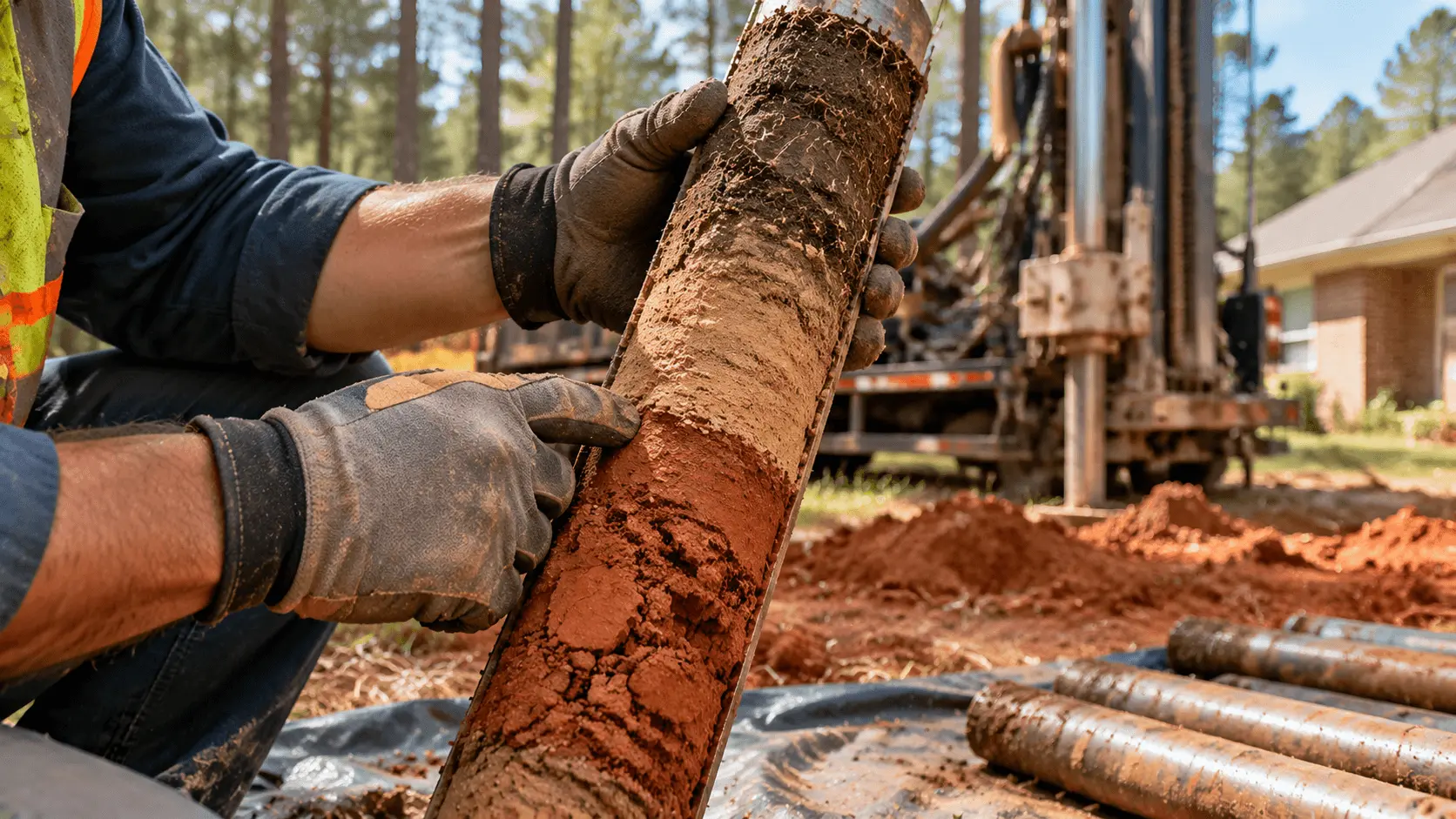
East Texas landscapes include differing sediment, soil layers, drainage conditions and past land use. A general statement that every property sits on expansive clay is not a substitute for evidence from the actual lot. Sandy surface horizons may occur above more clay-rich subsoils, and fill placed during construction can differ from native material. In parts of a property, compacted soil may support the structure differently from an adjacent area. Start with mapped soil information and the history of site grading, but recognize that a regional map does not show every buried trench or replacement fill. The correct interpretation depends on the structure, local groundwater and the behavior of the ground under its actual loads.
Using USDA Web Soil Survey for a specific address
The USDA Natural Resources Conservation Service provides Web Soil Survey so users can draw an area of interest and review mapped soil units and properties. It is a useful first step for understanding landscape context, not a house-specific geotechnical investigation. Soil map units may contain more than one soil component, and human changes since mapping can alter the site. Look for reported drainage, texture and limitations while noting the map scale and confidence. If an engineer needs to evaluate bearing capacity or significant movement, a site investigation may be required. Do not treat a general map color as proof of the precise soil beneath each footing. Save relevant maps as background for discussion with the evaluator.
How moisture changes may affect some clay layers
Clay-rich material can expand or contract as moisture conditions change, but the amount and direction of movement depend on mineral composition, depth, confinement and the overall soil profile. Surface weather may not reflect conditions at foundation depth. Wetting and drying near one side of a building can create different conditions across a footprint. A homeowner might observe cracks following seasonal changes, yet that timing alone does not identify the actual mechanism. Before deciding that the slab has heaved, a professional should consider settlement, drainage, plumbing, the type of foundation and the movement history. Attempts to correct moisture without a plan can create new gradients and damage rather than improving the situation.
Surface drainage and downspout effects
Water concentrated beside a foundation can change local soil moisture and contribute to erosion, ponding or crawlspace dampness. Overflowing gutters and short downspouts are observable starting points, but the right fix depends on where water can safely discharge. Sloping ground away from one wall must not send runoff into another vulnerable area or adjacent property. Swales, grading and drains should account for surrounding topography and maintenance. A structural assessment may still be needed if visible damage or movement is already present. Think of drainage as part of managing the conditions around a foundation, not as a promise that every crack will close. Document runoff during safe weather conditions and share the information with qualified providers.
Vegetation and the limits of simple watering advice
Trees and large shrubs may affect localized soil moisture through roots and water uptake, but their impact varies with species, soil, distance and climate. Removing a large tree or dramatically increasing irrigation can change soil conditions rather than simply fixing them. Avoid broad rules that a foundation must be watered a fixed number of minutes every day. Such advice ignores rainfall, soil profile, slope, drainage outlets and the foundation system. Look first for obvious leaks, broken irrigation and concentrated runoff. If a specific moisture-management plan is recommended, ask who developed it and what observations support it. Seek appropriate professional guidance before making major landscape or soil-water changes around a distressed building.
Why settlement and heaving can look alike
A downward movement in one area can make a nearby area appear relatively high, while true upward expansion can create a similar pattern of cracks and distorted floors. Existing construction tolerances complicate interpretation. A single elevation map cannot reveal the entire history, particularly if sections were previously adjusted or repaired. Look for the relationship between symptoms, foundation details and site conditions. Ask how a provider distinguishes loss of bearing from upward pressure and what evidence supports its explanation. Methods intended to stabilize settlement do not automatically solve heaving. When a recommended solution depends on knowing the direction and mechanism of movement, qualified engineering assessment may be important before expensive repairs begin.
Crawlspaces need their own moisture assessment
Raised-floor houses add another layer of complexity because damp soil, limited ventilation, plumbing leaks and drainage can affect wood as well as support foundations. Musty odors or visible deterioration do not establish that every pier has settled. A qualified evaluator should separate framing problems, moisture management and movement of discrete supports. Avoid entering cramped or unsafe areas without suitable access and expertise. If a provider proposes shimming or replacing beams, ask how the moisture source will be addressed and whether the support layout remains adequate. Document gutters, exterior grading and crawlspace drainage along with interior symptoms. Effective work may combine structural carpentry and water management, but the contracts should define those tasks separately.
What on-site evidence is useful
An inspection may include visual crack mapping, relative elevation measurements, review of drainage routes, accessible foundation details and the history of past work. Site-specific geotechnical testing can be warranted for complicated movement or major structural decisions. The evaluator should identify uncertainties and explain why any testing is needed, rather than assuming a particular soil layer exists without evidence. Photographs of cracking are helpful but cannot show the ground beneath buried footings. Request a summary distinguishing observed conditions from inferred causes. If the company is proposing a specific pier depth or bearing mechanism, ask how those assumptions will be validated during installation. Credible decisions connect evidence, diagnosis, method and documented outcome.
Seasonal changes and long-term monitoring
Wet and dry periods can influence the appearance of some distress, but seasonal timing is only one clue. A foundation may have historic movement, a recent plumbing problem or changes from grading and construction nearby. Keep a dated record of symptoms, weather extremes, water-use changes and any repairs. Consistent relative measurements over time may help determine whether movement is continuing, although they still require professional interpretation. Avoid filling every crack before it has been documented if a formal assessment is scheduled. Sudden or significant displacement should not be treated as an ordinary seasonal cycle. The goal of monitoring is to provide context for decisions, not to postpone necessary safety evaluations.
Questions to ask about the proposed repair
Ask which soil or support mechanism the provider believes is responsible, what direct observations support it and what alternatives were considered. Determine whether proposed piers transfer loads to suitable material, whether drainage measures are required and what movement the selected design is expected to address. Request the locations and performance criteria in writing. If a plan claims to correct both settlement and heaving, seek a clear engineering explanation rather than relying on marketing terminology. Clarify what parts of the site will remain susceptible to moisture changes and what ongoing maintenance is recommended. Compare written scopes and consider independent engineering advice when the interpretation or cost is disputed.
Use soil information as context, not a diagnosis
A homeowner can productively review public soil maps, drainage history and the appearance of foundation symptoms without concluding that the house has a particular structural defect. Gather the property address, relevant construction records, dated photographs and earlier repair information for an evaluator. National soil mapping resources offer broader context; a real foundation recommendation requires building-specific evidence. If the situation involves large movement, unsafe structural conditions or conflicting sales proposals, hire an appropriately qualified professional for an independent assessment. The best outcome is a plan proportional to the observed risk, with clear uncertainties and responsibilities. This educational website does not conduct soil testing or issue engineering opinions itself.
Homeowner action checklist
Use the questions below to prepare for a professional discussion rather than trying to diagnose or lift your home yourself.
- Look up the property in USDA Web Soil Survey
- Review grading and standing-water locations
- Identify major fill changes or excavation history
- Record movement symptoms without presuming the cause
- Ask whether site-specific testing is warranted
What should happen next?
When information is incomplete or contractors provide conflicting recommendations, consider an independent Texas-licensed professional engineer for a defined assessment. Compare written repair scopes and warranty terms before selecting a provider.
If immediate structural safety is uncertain, avoid affected areas and contact the appropriate qualified professional or local emergency resource.